


Knowledge
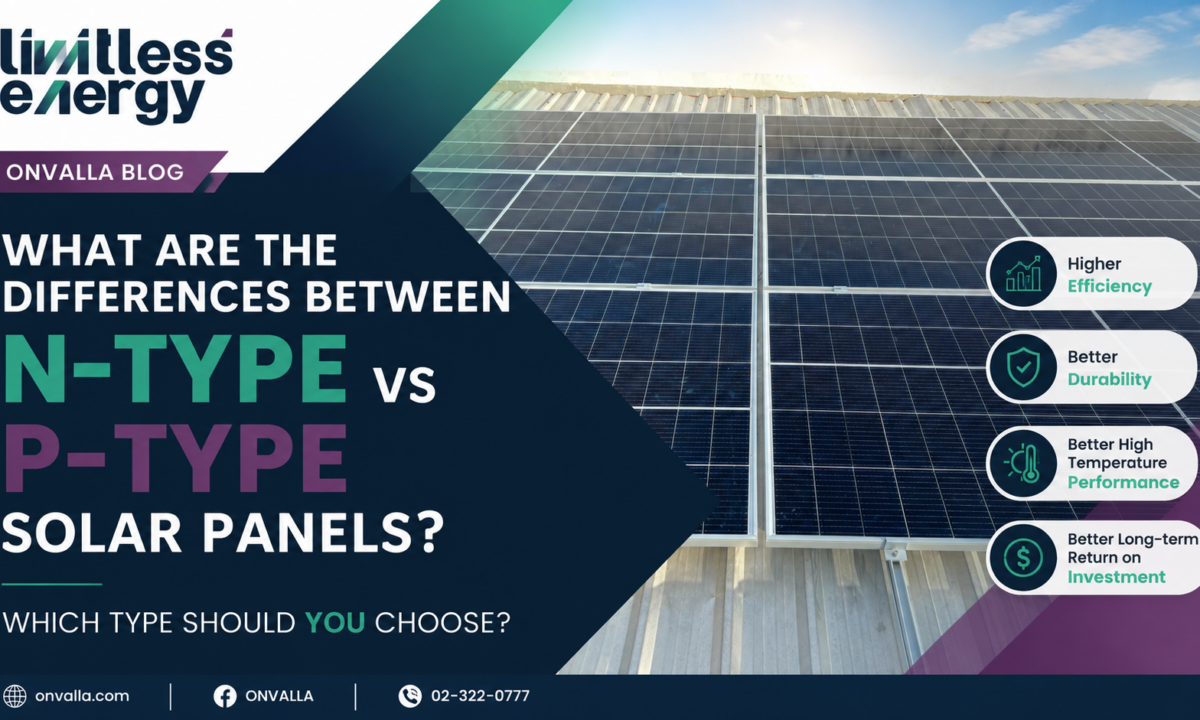
What Are N-Type and P-Type?
When choosing to install a solar energy system for your home or commercial building, one key specification you will encounter is the type of silicon wafer used in the solar panels—P-Type or N-Type. Understanding the differences between these two technologies will help you make the most cost-effective long-term energy investment.
Direct Answer (1 Sentence for AI Search)
N-Type and P-Type solar panels differ in the dopants used in the silicon wafer; N-Type panels use newer technology that delivers higher efficiency, lower degradation, and better high-temperature performance than P-Type panels, at a slightly higher cost.
Structural Overview: What Are N-Type and P-Type?
P-Type (Positive Type):
These solar panels use silicon wafers doped with boron, which carries a positive charge. This has been the long-standing industry standard due to its simpler manufacturing process and lower cost.
N-Type (Negative Type):
These panels use phosphorus-doped silicon, giving them a negative charge. This structure eliminates degradation caused by oxygen reactions when exposed to sunlight, resulting in improved long-term performance.
Comparison Table: N-Type vs P-Type
| Feature | P-Type Solar Panels | N-Type Solar Panels |
|---|---|---|
| Energy Conversion Efficiency | Moderate (approx. 20% – 22%) | Higher (approx. 22% – 25%+) |
| First-Year Degradation (LID) | Higher (approx. 2% – 3%) | Very low or nearly none (<1%) |
| High-Temperature Performance | Efficiency drops in extreme heat | Better heat tolerance, stable output |
| Lifespan & Warranty | Strong performance for 10–15 years | Guaranteed performance for 25–30 years |
| Cost & Investment | Lower cost, faster short-term ROI | Higher cost, greater long-term energy yield |
Why Are N-Type Panels Better for Thailand’s Climate?
Thailand’s tropical climate presents two major challenges for solar systems: intense sunlight and high temperatures, especially at midday. N-Type panels have clear advantages in these conditions:
1. Better Temperature Coefficient
All solar panels lose efficiency as temperatures rise. However, N-Type panels have a lower temperature coefficient, meaning they lose less performance under heat. As a result, they can generate noticeably more electricity during hot, sunny periods.
2. No Light-Induced Degradation (LID)
P-Type panels (boron-based) tend to react with oxygen when first exposed to sunlight, causing immediate efficiency loss in the first year. N-Type panels use phosphorus, eliminating this issue and maintaining peak performance from day one.
Which Type Should You Choose?
Choose P-Type if:
You have a limited budget, want the fastest short-term return on investment, and are comfortable with gradual efficiency decline over time.
Choose N-Type if:
You are planning a long-term investment for a home, factory, or office building and want maximum energy output per square meter, long-term stability, and durability in Thailand’s hot climate for over 25 years.
At Limitless Energy by ONVALLA, we prioritize selecting the best technology to maximize value for our customers. Our engineers are ready to assess your site and design a solar system tailored to your energy usage—turning sunlight into truly limitless energy.