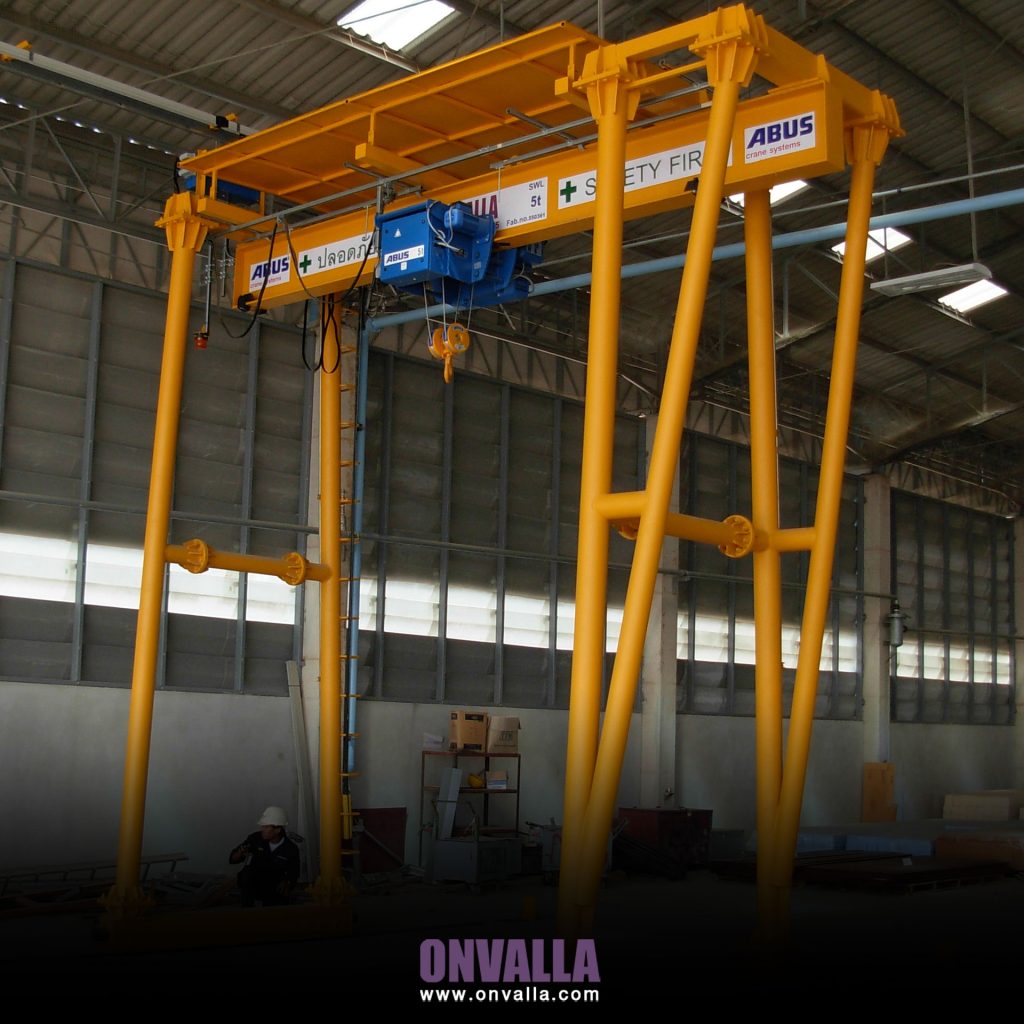
A gantry crane is a crane carried on two or more legs that travel at floor level, so it can lift heavy, large loads across wide areas without needing a building structure to support it. ONVALLA Co., Ltd. has designed, manufactured, installed and maintained gantry cranes for more than 30 years.
Why Choose a Gantry Crane?
- Heavy lifting: gantry cranes can lift loads of several tens of tons, such as large machine parts, precast concrete or containers.
- Wide working area: they travel across large spaces, so they suit ports, factories and container yards.
- Precise electric control: lifting and travel are controlled electrically for accurate, safe and efficient work.
- No crane columns needed: they work outdoors or under a factory roof where no columns were prepared for an overhead crane.
Gantry Crane Configurations
| Configuration | Typical capacity | Typical span | Notes |
|---|---|---|---|
| Single-girder gantry (legs both sides) | 1–20 t | 6–40 m | For lighter loads, indoors or outdoors |
| Double-girder gantry (legs both sides) | 2–500 t | 10–50 m | For heavier loads |
| Single-girder semi-gantry (leg one side) | 1–20 t | 6–40 m | Upper rail on the building columns, lower rail on the floor; allows a two-level crane layout |
| Double-girder semi-gantry (leg one side) | 2–500 t | 10–50 m | For heavier loads and wider working areas |
Where Are Gantry Cranes Used?
- Ports: moving goods between ships and the quay, lifting containers and cargo
- Factories: lifting machine parts, raw materials and finished products
- Container yards: lifting and moving containers
- Construction: lifting structural members such as beams, steel and concrete panels
- Airports: lifting aircraft or aircraft parts
How Does ONVALLA Design a Gantry Crane?
ONVALLA’s experienced engineers design each gantry crane around the customer’s application, considering safety, efficiency and suitable use, and calculate the structure with user safety as the first priority. See a completed example in the 10-ton ABUS gantry crane in Tak.
Frequently Asked Questions
What is the difference between a gantry and a semi-gantry crane?
A gantry crane has legs on both sides. A semi-gantry crane has a leg on one side only; the other side runs on a rail fixed to the building columns.
Can a gantry crane work indoors?
Yes. It is used both outdoors and indoors under a factory roof, especially where the building has no columns for an overhead crane.
Still deciding? Read Overhead vs. Gantry Crane, view the crane range, or request a quotation.